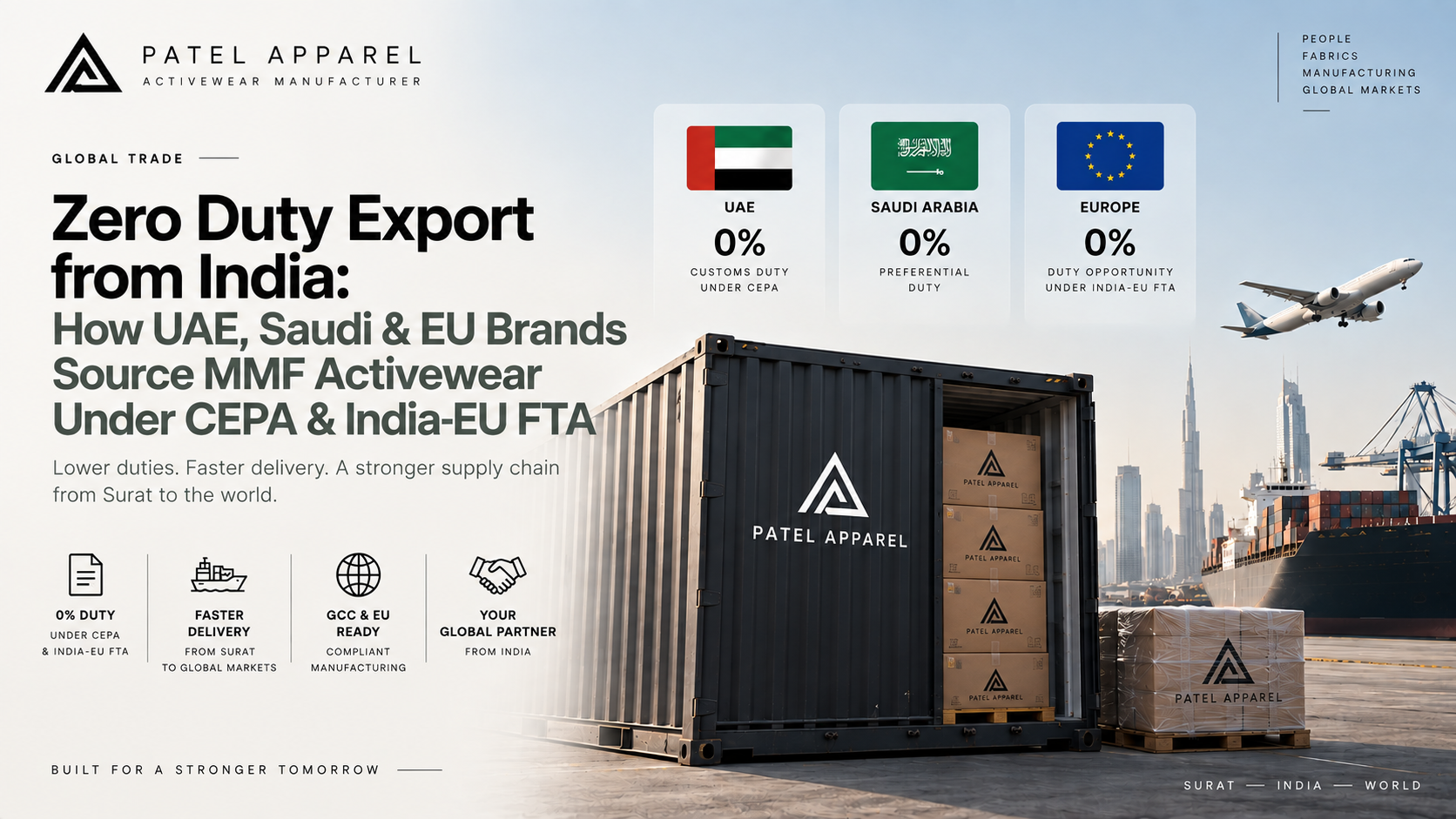
Global fashion procurement is undergoing a massive realignment: Red Sea shipping disruptions cause 3-4 week delays from East Asia, Chinese imports incur 5% import duties in the GCC and 9-12% in the EU, and sourcing heads are mandated to diversify supply chains via China+1 risk mitigation.
1. The UAE CEPA Advantage: 0% Customs Duty
Signed in 2022, the India-UAE Comprehensive Economic Partnership Agreement (CEPA) covers over 97% of tariff lines. Apparel imported from India into the UAE qualifies for 0.0% Preferential Duty (vs 5.0% standard duty on Chinese imports). Patel Apparel handles all export documentation and Preferential Certificate of Origin (COO) certificates for seamless customs clearance at Dubai ports.
2. GCC-Calibrated Patterns: Stop Fitting European Blocks on Gulf Consumers
Standard Asian and European pattern blocks fail on regional GCC proportions. Patel Apparel maintains a library of GCC-Calibrated Master-Fit Patterns featuring higher rear pelvic rise, roomier thigh and quad cuts, and adjusted inseam length grading designed specifically for Middle Eastern retail accounts.
3. Bharat Mart Dubai & European Nearshoring Strategy
- Bharat Mart Dubai: 4-day sea freight from Surat (Hazira/Nhava Sheva) to Jebel Ali for 48-72h regional store replenishment across Saudi Arabia, Qatar, Oman & Kuwait.
- European Compliance: AATCC 135/150 wash testing, ISO 12945-2 pilling resistance, and 100% single-roof ethical manufacturing.
- HS Codes Supported: 6103.43 & 6104.63 (Men's/Women's synthetic trousers/shorts), 6109.90 (Synthetic t-shirts).
Request an Export Spec Sheet and CIF quotation directly on WhatsApp from Founder Tagesh Patel (+91 9104488942).


