
Every fashion founder plans their launch marketing, Shopify theme, and Instagram aesthetic. Almost none plan their production backend. The traditional path for D2C apparel founders in India locks up ₹5 Lakhs in unproven stock and 6-week sampling delays. This guide provides a capital-efficient 15-day launch blueprint.
The ₹5 Lakh Reality Check: Why 80% of Apparel Brands Fail Before Unit 1 Ships
When founders start a brand, they usually contact local factories on IndiaMART or visit Tirupur. The factory demands a 1,000 to 5,000-unit Minimum Order Quantity (MOQ) per style, burns ₹40,000 in prototype fees across 6 weeks of sampling, and ghosts calls after a 50% deposit while prioritizing larger export orders. When inventory arrives, sizing is inconsistent and 30% of capital is trapped in unsold stock.
1. Capital Allocation: Where Your ₹1.5L to ₹5L Budget Actually Goes
Starting a D2C activewear or streetwear brand does not require ₹20 Lakhs. It requires capital efficiency. By using pre-validated Master-Fit pattern blocks, you eliminate ₹40,000 in prototype fees and 4 weeks of back-and-forth sampling.
- Tech Pack & Sampling: ₹0 (Using pre-validated Master-Fit blocks vs ₹50k traditional)
- First Production Run (100–300 units): ₹60,000 – ₹1,20,000 (vs ₹2.5L–₹4.0L traditional)
- Branding & Packaging: ₹10,000 (Custom printed neck tags & mailers)
- Shopify & E-Commerce Tech Stack: ₹15,000
- Initial Performance Ads & Content: ₹50,000
- Total Working Capital Required: ₹1,35,000 – ₹1,95,000 (Lean Launch Sprint)
2. The MOQ Ladder: Validate at 100 Units, Scale at 500 Units
Do not lock ₹3 Lakhs into 1,000 units of an unproven design. Use the MOQ Ladder to preserve liquidity: Step 1 (White Label Validation, 100 Units, 2–7 Day Dispatch) applies custom woven labels and mailers to pre-manufactured catalog blanks. Step 2 (Private Label Sprint, 500 Units, 7–15 Day Dispatch) customizes fabric GSM, Pantone colorways, and specialized prints once SKUs hit a 60%+ sell-through rate.
3. Why Surat MMF Beats Tirupur Cotton for Activewear & Streetwear
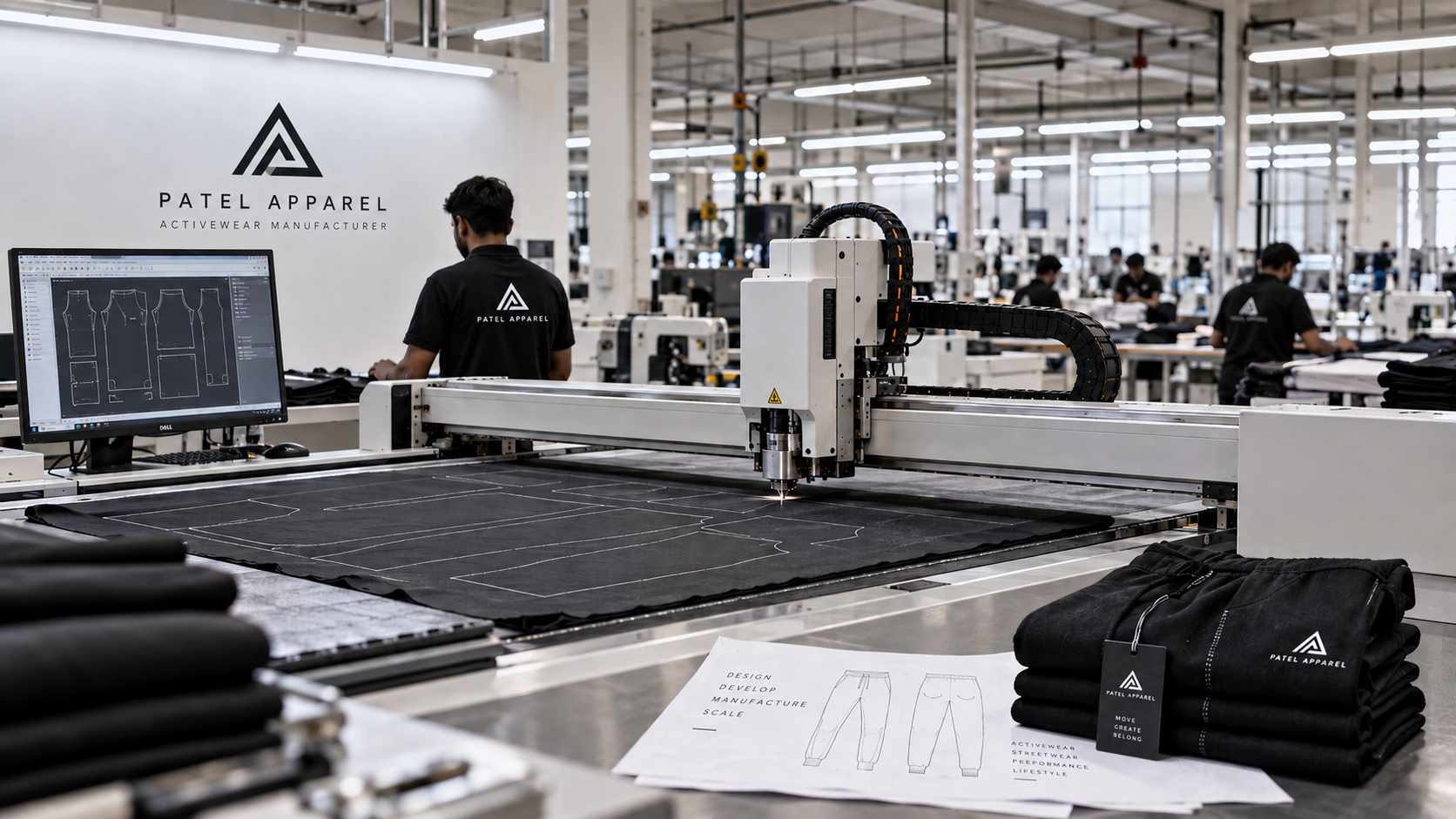
If you are manufacturing 100% cotton basic t-shirts, Tirupur is a legendary hub. But modern athleisure, track pants, joggers, and utilitarian streetwear are 90%+ Man-Made Fiber (MMF)—utilizing 4-Way Lycra, Nylon Spandex (NS), Dry-Fit Mesh, and Polyester Interlock. Surat is India's MMF capital. Sourcing technical finished fabrics in Surat happens the same afternoon your deposit clears because local mills are within a 15km radius of our single-roof factory floor.
“Surat's native MMF ecosystem allows same-day fabric procurement from local mills, enabling a 7 to 15-day delivery sprint under single-roof control.”
4. The 15-Day Manufacturing Sprint Blueprint
- Day 0: WhatsApp Inquiry & 2-Hour Itemized Quote
- Day 1: 50% Advance & Same-Day Fabric Sourcing in Surat
- Day 2: CAD Marker Planning & Precision Cutting
- Days 3–10: Single-Roof Flatlock Assembly & In-House Printing
- Days 11–13: Retention QC (AATCC 135/150 Wash Stability & ISO 12945-2 Pilling)
- Days 14–15: Packaging & Courier Dispatch
Ready to launch? Speak directly with Founder Tagesh Patel (+91 9104488942) on WhatsApp to request our 100-Unit White Label Catalog and Cost Calculator.


